
Delle perle di Akoya
History and morphology
Of the Shih Tzu

History
People tend to confuse the Lhasa Apso with the Shih Tzu, but there are many differences between them. This breed's roots are in Tibet, but it developed in China, where similar dogs lived in imperial palaces. China became a Republic in 1912, after which specimens of the breed found their way to the West, although the first importation into England was not documented until 1931. It was recognized as a breed separate from other Oriental breeds in 1934 and received its own Kennel Club Stud Book in 1940, with championship certificates available from 1949. The Shih Tzu's chrysanthemum-like appearance on its head is very attractive, and is caused by the growth of hair above the nasal bridge.


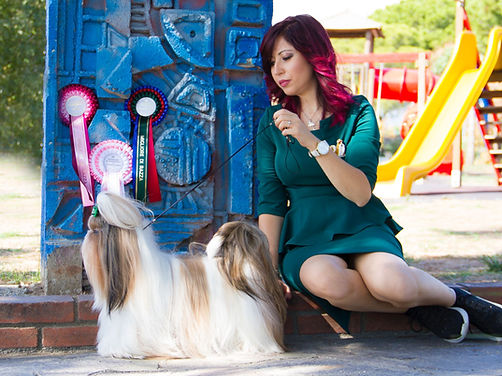
Morphological standard
Robust dog, abundantly covered with hair but without exaggeration, with a characteristic bold bearing and a “chrysanthemum” muzzle.
The length of the body measured from the withers to the base of the tail is greater than the height at the withers.
The head is broad, round, and wide between the eyes. It has a shaggy coat, a good beard, and a mustache. The hair that grows upward, above the bridge of the nose, gives the typical "chrysanthemum" effect. The coat should not interfere with the dog's vision.
CRANIAL REGION: Stop: Defined.
Nose: Black, but dark liver in liver-colored or liver-marked dogs. The tip of the nose should be in line with, or slightly below, the lower eyelid line. The nose should be horizontal or slightly upturned. The nostrils should be wide open. A nose with a downturned tip is highly undesirable, as are narrow nostrils.
Muzzle: Very broad, square, short, without folds, flat, and heavily coated. The length is approximately 2.5 cm from the tip of the nose to the stop. The muzzle pigmentation should be as uninterrupted as possible.
Level lips.
Mouth wide, slightly undershot or jaws of equal length (pincer bite, edge to edge). Eyes large, dark, round, set well apart but not protruding. Gentle expression. In liver-colored or liver-marked dogs, a lighter eye color is permitted. The whites of the eyes should not be visible.
Ears large, with long cartilage, carried drooping. Set slightly below the crown of the skull.
The ear is so abundantly covered with hair that it seems to become one with the fur on the neck.
Neck well-proportioned, gracefully arched. Long enough to carry the head proudly.
Back: Horizontal.
Rene: Compact and robust.
Chest: Broad, deep and well let down.
Tail: Profusely plumed, carried gaily over the back. Set high. It reaches approximately level with the skull to give a well-balanced profile.
Shoulder: Firm, well laid back.
Forearm: Short and muscular with good bone: as straight as possible; in harmony with the broad, well-deep chest.
Forefeet: Round, firm and well covered with hair.
Hindquarters: Short, muscular, with good bone. Straight when viewed from behind. Upper thigh: Well-rounded and muscular. Hind feet: Round, firm, and well-padded. Well-furred.
Confident, fluid gait, with good reach of the forelegs and strong drive of the hindquarters which fully show the pads.
The outer coat should be long, dense, and not curly, with a moderate undercoat that is not woolly. Slight wave is permitted. The coat should not obstruct the dog's vision. The length of the coat should not restrict movement. It is strongly recommended that the head hair be tied back without ornamentation.
All colors are permitted; white blaze on the forehead and white on the tip of the tail.
Height at the withers: no more than 27 cm.
The type and characteristics of the breed are of the utmost importance and must in no way be sacrificed to the sole criterion of size.
Weight: 4.5 to 8 kg. Ideal weight 4.5 – 7.5 kg